Loop Engineering vs. Prompt Engineering: Is This Actually a New Skill?

Long before anyone called it "loop engineering," developers working heavily with coding agents had already converged on the same workaround: a plain text file where every mistake the agent made got written down as a standing correction, so the next session didn't repeat it. Anthropic's own Claude Code team was reportedly doing this internally — feeding recurring errors back into a file like CLAUDE.md — well before the practice had a label attached to it.
That's the part worth noticing. The behavior came first. The system — catch the mistake, record it, feed it back in, check the result before calling anything finished — existed before the industry had a name for it. By the middle of 2026, it had one, and the name is the reason we're all suddenly arguing about it.
What "Loop Engineering" Actually Means
The term crystallized in a single week. On June 7, 2026, developer Peter Steinberger posted a blunt line to X: stop prompting coding agents by hand, start designing the loops that prompt them for you. It reportedly hit millions of views within days. Around the same time, Boris Cherny, who leads Claude Code at Anthropic, had been making a similar point in interviews — that his actual job had shifted from writing prompts to writing the loop that decides what gets prompted next. Google engineer Addy Osmani gave the idea a clean, teachable shape almost immediately after, and the label stuck.
Stripped of the hype, the definition is fairly plain: a loop is a system with a goal, a way to act toward it, a way to check the result, and a rule for when to stop. That's meaningfully different from a single prompt, which asks once and takes whatever comes back. A loop keeps going — reading test output, catching its own errors, retrying — until a condition is actually met, not until a person gets tired of prompting.
Real Shift, or Just a Rebrand?
Not everyone is convinced this deserves its own name. A widely shared critique on Hacker News made the case plainly: a "loop" is just a while-loop with an LLM call inside it, and "evaluation" is just a unit test with new packaging. Anyone who has written a CI pipeline, the argument goes, has been doing a version of this for years — they just didn't call it engineering a loop, they called it engineering a pipeline.
There's real weight to that. The mechanics genuinely aren't new. Feedback loops, retry logic, automated verification — these are old ideas in software. What changed isn't the concept; it's the cost of building one. Until recently, wiring an agent into a working loop meant writing and maintaining your own scripts, your own retry logic, your own state tracking. That infrastructure now ships natively inside tools people already use daily. The pattern used to require real plumbing work. Now it's closer to flipping a setting.
So call it what you want — loop engineering, agentic orchestration, "a while loop with better PR." The label is arguably overhyped. The underlying shift in what's now cheap to build is not.
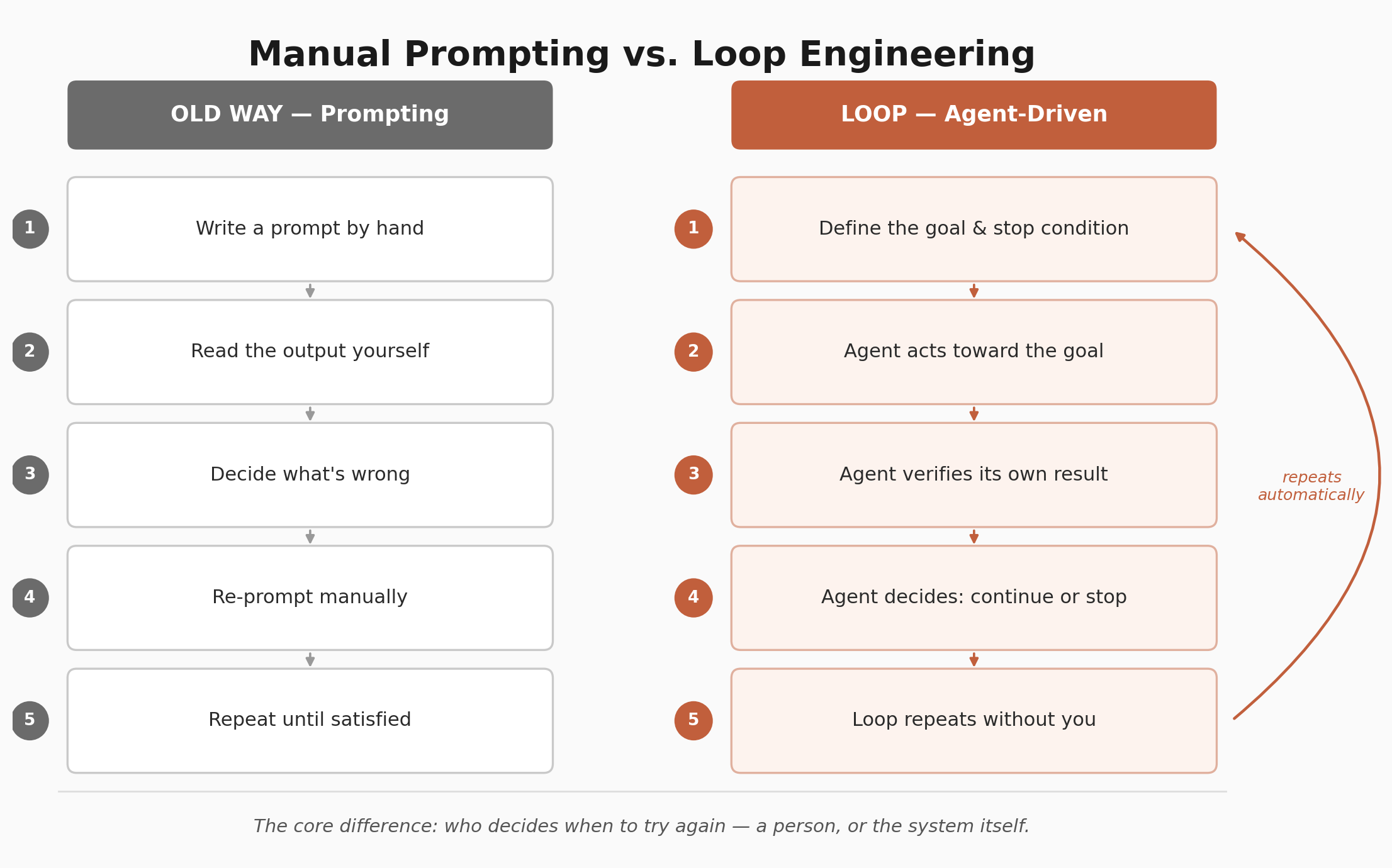
The Part Almost Everyone Skips
Here's the detail that gets buried under all the buzzword coverage: the hard part was never the loop. It's the verifier — the thing deciding whether the output is actually good, or just looks finished.
Some goals make this easy. "All tests pass" is checkable by a machine with zero ambiguity. A loop built around a goal like that converges cleanly, because there's no room for interpretation about what "done" means.
Most real work isn't that clean. "Build this feature well" isn't checkable by a script. If the stopping condition is vague, the loop doesn't converge on quality — it converges on output that merely looks plausible, because that's the only signal it has to optimize against. An agent will happily run for hours producing confident, well-formatted, subtly wrong work if nothing in the loop is actually equipped to catch that. This is where loop engineering succeeds or quietly fails, and it has almost nothing to do with how the loop itself is wired.
What To Actually Do About It
Skip the temptation to build an elaborate autonomous system on day one. Start smaller: before automating anything, write down what "done" means for the specific task, in terms specific enough that a machine — or a strict colleague — could check it without asking a follow-up question. If you can't state the finish line in checkable terms, you're not ready to build a loop around it yet; you're still doing prompt engineering, and that's fine.
The label will probably fade the way "prompt engineering" already has. The underlying discipline — knowing exactly what "correct" looks like before you let something run unsupervised — won't. That's worth learning regardless of what the industry decides to call it next.
Comments
Join the discussionNo comments yet. Be the first to comment.